
PerforModule Recommends: Ideal Peak Levels

Kind of like every human being has a height value, every audio clip has a peak level value. So what can we do with that information, beyond knowing that going above 0dB usually isn’t advised? In our eternal quest for ultimate audio quality, the inclination can be inherent to record loudly—as close to 0dB—as possible, and thereafter maintain that peak level. We fear that by mixing with track levels that are too quiet, we might be losing fidelity, some harmonic detail in the saturation floor or something.

While it is true that recording analog signals as loudly as possible without signal clipping to begin with will indeed minimize noise floor, the benefits reaped by maximizing peak level for individual tracks tapers off as you get closer to zero. At what peak level are audio sources louder than they really need to be? At what level are they too quiet, that they might need to be boosted excessively later? Using an algorithm based on the energy of how sounds stack together, i devised a set of go-to ranges for peak levels based on track counts. Since peak levels can vary fairly wildly based on content, you are given minimums and maximums (instead of single target values). Juicy details ahead… Continue reading →
2 New Packs Now Available at Isotonik Sounds: “Spirit Beats” and “ADM AMBIENT”

As curator of Isotonik Sounds packs for Ableton Live, i’ve gotten the chance to preview some amazing material. It’s been a great honor to be tasked with pinpointing unique and interesting artists and nurturing their product development.    -animus invidious
Continue reading →

Optimizing a New Windows PC for Audio Production (w/Profanity)

Having recently acquired a new custom-built PC, various steps implemented to optimize its performance and usability were taken note of. While not an expert in such things, i figured to share these tips in case they may prove useful. Keep in mind that this guide is presuming that you already dabble in audio production and are upgrading to a new—from an existing—system.

Continue reading →

Isotonik Sounds Launches with New Sale Packs

Isotonik Sounds has officially launched, a section at the Isotonik Studios webshop featuring instrument and sample packs for Ableton Live by various developers.

New sale packs will periodically be made available. The first is ADM DRUMS by yes, you guessed it, the acclaimed wizard of Live: AfroDJMac.

Continue reading →

Ableton Live 10: New Feature Highlights

So i’ve been delving into the Ableton Live 10 Beta for a little bit now, did a couple of large mixes and some experimenting with it, and have accumulated a fair impression of how it differs from Live 9.

Ableton Live 10 ~ What’s to Like?

I’ll run over some of the things i’ve noticed in particular which stood out to me, while slipping in mentions of more minor program enhancements. Everything i explain below i will have confirmed personally with Live 9 and Live 10 side-by-side testing.
You’ll notice i completely ignore some new features. These are things i’ve either not tested yet, don’t care about, or would take too much time to dive into properly here. I not even touching on the new instrument or effects (yet…)
My overall impression of Live 10 is that they added in a lot of workflow improvements i didn’t know i wanted. Continue reading →

PerforModule Mega Collections!

Restructuring

The PerforModule Pack Collections at Isotonik Studios have been restructured.

There are now 3 main collections which together comprise every one of my sale packs. These are by far your best deal ever at accumulating PerforModule goodies:

DynaMixing Ultimate

This consists of a single “mega” pack which contains a consolidated collection of ALL the racks from 6 entire previous packs: DynaMixing One through Five plus Ionic FX.
All devices from those packs are now accesible from a single browser location. Convenient!
These are tools designed for enhancing your workflow for mixing, allowing you to sculpt your sound with robust, innovative capabilities quickly. Many of them include “artificially inteilligent source reactivity” using envelope followers listening to different parts of the input signal to “automagically” modify parameters in real time.
Currently totaling 88 awesome effect racks!
Personally… i use racks from this pack all. The. Time. For mixing. So many of the tools are just the fastest and easiest way to get to a refined result i’m looking for. Down below you can check out some personal favorites and what i might use them for.

Clinicality Collection

These include packs which are of a technical nature, giving you a huge range of tools for very specific tasks. Be all scientifical about stuff!
Includes the packs:

  • Advanced Splytters
  • Amplitude Operands
  • Dephaultz
  • Groovification 1
  • Groovification 2
  • Harmonicality
  • Note Range Setters
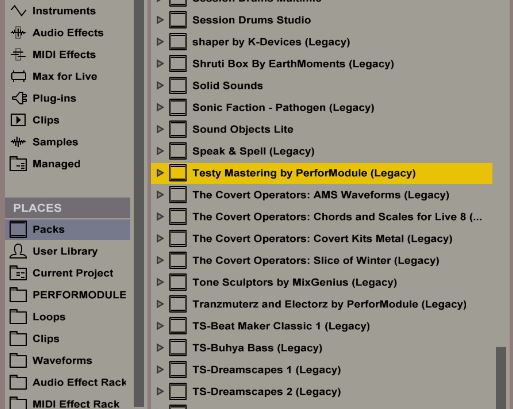
  • Testy Mastering
  • Tranzmuterz & Electorz

Niche Collection

Here reside the fun, wacky, and creative batch of oddities providing instruments and effects for “niche” purposes, great for when you want to be spontaneous and just make stuff.
Includes the packs:

  • Bussification
  • Drum Enhancerz
  • Guitaritis
  • One Knob Wonders
  • Planetary Convolution
  • PMX FX Plus
  • PerforModucussion
  • Uno Plus Series


Update News

Continue reading →

A Limiter Tournament

So i set up a Limiter Tournament (using a variation on single elimination style) to decisively rank my Clipper/Limiter/Maximizer plugins against each other. Unlike with compression, which i often like to use for adding character, injecting density, and enhancing groove, my primary purpose for limiters tends to be to increase headroom by curtailing short transient peaks, leading to a consistent, clean output. For this reason, it is not so impractical for me to classify some limiters as “better” than other (unlike with compressors). This is also the reason why i am including clippers and limiters both in the same tournament. Limiters tend to pump and Clippers tend to distort, but lots of plugins have characteristics of both, and the basic purpose is the same for both: to reduce the pokiness of peaks which are so fast we don’t really hear them anyways. Maximizers? What the fuck are those? There is no consensus as different developers release things they call “maximizers” which do different things, but in general, they combine peak limiting with either low-level compression or saturation.

4 limiter/clipper/maximizer models at a time were pitted against each other in contests using HOFA BlindTest with clips gradually pushed into 35dB of limiting, gain-matched using Melda’s MAGC to be able to hear only dynamics, tone, and distortion characteristics without loudness levels affecting perception.

Continue reading →