Push 3: User Mode — Free Template.

‎‎

Custom Controller Mapping.

 Just about every Ableton Push owner I’m acquainted with: “Yeah, I know the Push has a mode for custom MIDI mapping… but I don’t really use it for anything.”

 I have at times gone to inordinate lengths to map controllers so they have as many different useful functions as possible. So upon finally acquiring a Push for myself, I was eager to brainstorm how best to integrate its User Mode into the grand scheme. Well, it took awhile, but I got something!

 [Screw all this reading…skip down low to the free download.]

Non-Adjustable Values!?!

 I soon found out that the MIDI values sent by Push in User Mode are non-adjustable. What? That sucks. Kinda surprising for such an advanced controller.
 There being no obvious immediate way around this issue without weird re-routings or whatnot, I went ahead and re-adjusted my existing MIDI plan to work with the Push 3’s User Mode values. Certain spreadsheet shenanigans and much remapping later, it all integrates together happily. Woohoo! It seems that inclusiveness can be beneficial after all.

 [For example, Push User Mode’s D-Pad Left button triggers CC 44 of midi channel 1, and it’s been mapped to Locator: Previous in my template. The Korg PadKontrol also has a patch I want to have Locator controls for, so that has likewise been set to CC 44, channel 1 so that both controllers can accomplish the same function.]

 One perk of non-adjustable mappings that the template ought to work identically for anyone with a Push 3 — no work needed on your part. Right on.

A Toggly Dilemma.

 …But there’s another issue! Most of Push’s buttons in User Mode send values when pressed and when released, acting as a toggle such that if you map them to a switch-type control, the value will go on when you press the button, and off when released. This can cause problems for certain types of controls… like if mapping to Play it unavoidably creates an undesirable stutter.
 The toggle behavior CAN be useful — but only really when you want a momentary-type control (that stays on while held, then turns off when released). Cool for some things, like holding a button to momentarily enable Draw Mode or Automation Mode.
 These differ from key commands that can be momentary (such as ‘A’ for Automation Mode) in that they are less flexible — the Built-in Key Commands can be momentarily flipped off or on depending on their initial state, and can be toggled with a swift tap — whereas the User Mode Commands will always be on when held and switched off when released, no matter what.
 [Note that you can invert this behavior, so that pressing the button turns the control off and releasing it turns it on, by changing the mapping’s Mode; go into midi-mapping mode, then click on the midi map control you want to alter and change the Mode from Absolute to Relative (signed bit). Make sure to test it because not all of the controls respond exactly the same.]

 I’ve brainstormed out functions that are either tolerable or genuinely beneficial and tried to map them to the most sensible controls. There’s a lot of subjectivity in those decisions so lmk which you find to be keenly insightful or a wackful waste.


Push 3 User Mode Control Mappings.

 There’s a lot going on here, so let’s take it in pieces, starting at the bottom-left and moving clockwise-ish around.


Section One:
A Bunch of Miscellaneous Functions.

Tempo Encoder Twist: Clip & Looper Quantize.
Cycles the Quantize setting for both Clips and for the Return Looper.

Tap Tempo Button: Tap Tempo.
 Works the same as in non-user mode.

Metronome Button: Momentary Metronome.
 Enables the metronome only while held down. Great for when you want to quickly check the tempo & time signature.

Quantize Button: Fold to Scale.
 In the Midi Note Editor, toggles only showing notes of a clip’s chosen scale.

Fixed Length Button: Momentary Draw & Preview.
While held, both Draw and MIDI Note Editor Preview are switched on, allowing to quickly draw notes while hearing them before switching back to editing mode by letting go of the button. [I find this to be one of the most helpful controls!]

Automate Button: Momentary Automation.
 In Arrangement View, switches Automation Mode on while held, good for quick automation edits.

New Button: New Recording Scene.
 Presses the hidden Prepare New Scene for Recording button, which can be indispensable for off-the-cuff improv recording sessions.

Capture Button: Capture.
Works the same as in non-user mode.

Record Button: Momentary Session Record.
 Turns on Session Record, but only while held. Useful for quickly recording automation in clips without accidentally leaving recording on afterwards.

Play Button: Launch Track 1 at Selected Scene.
 In the template this is mapped to launch Track 1 at whichever Scene is highlighted, allowing you to launch clips on Track 1 at any time without having to shift focus from another track.

Pitch Bend Touchstrip: Pitch Bend.
Works the same as in non-user mode. You could map this to something, but then it ceases working as a pitchbend for instruments.


Section Two:
Global Quantize, Tempo Nudge, Momentary Envelope Lock, Stop, Momentary Solo Mid or Side.

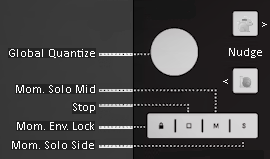
Volume Encoder Twist: Global Quantize.
Cycles the Global Quantize setting.

Lock Button: Momentary Envelope Lock.
Enables Lock Envelopes mode only while held. Use this to move something in the arrangement without taking any overlapping automation along.

Stop Clip Button: Stop.
Stops playback.

Mute Button: Momentary Solo Mid.
Mapped in the template to solo the Center (‘M’) signal while held.

Solo Button: Momentary Solo Side.
Mapped in the template to solo the Sides (‘S’) signal while held.

Undo Button: Tempo Nudge Faster.
Tap or hold to gradually & temporarily increase tempo.

Save Button: Tempo Nudge Slower.
Tap or hold to gradually & temporarily decrease tempo.


Section Three:
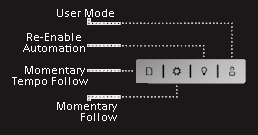
Momentary Follow Modes, Re-Enable Automation, User Mode.

Sets Button: Momentary Tempo Follow.
Enables Tempo Follow while held. Use it to quickly listen to and re-grab the tempo from an external source before going independent again.

Setup Button: Momentary Follow.
Hold it down for the Arrangement View to follow the playback cursor. Let go when it’s where you want to do an edit and the screen will stay parked there, despite playback continuing. Or, tap it once to ‘teleport’ to an off-screen moving playback cursor. This is super handy for seamless edits whilst listening through material!

Learn Button: Re-Enable Automation.
If you have any Session View clips with recorded clip parameter automation (which you should), and you adjust them live, the automation becomes broken (temporarily bypassed). Tap this button to restore clip automations.

User Button: User Mode switch.
Works the same as in non-user mode. It does also send a MIDI note if you want to map something to occur whenever modes are switched.


Section Four:
FX Macros, Audio & MIDI Track Selectors.
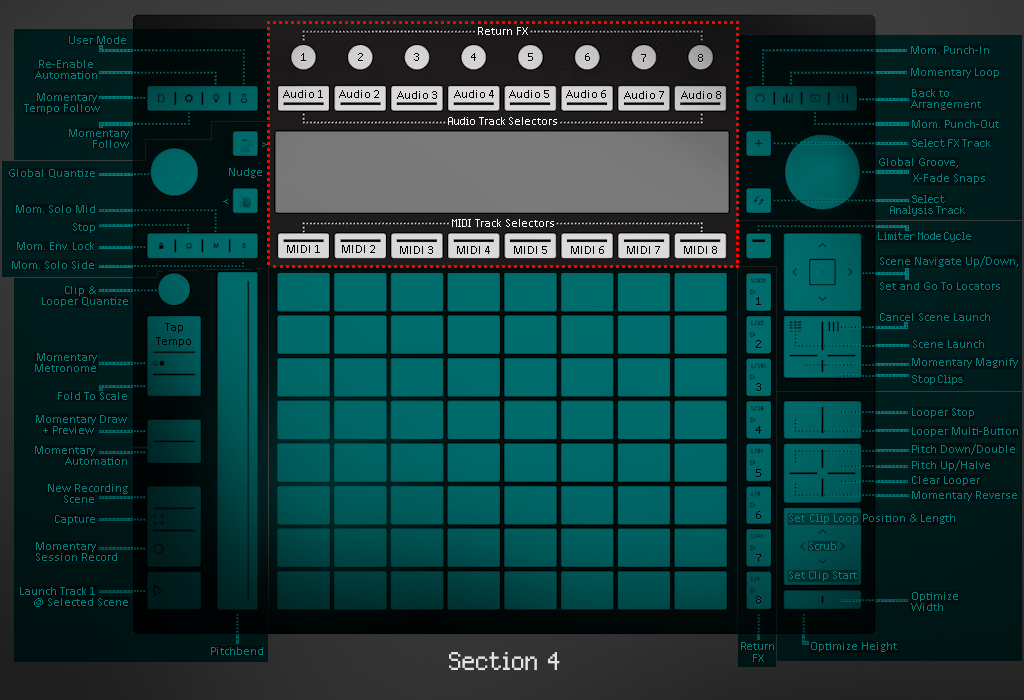
Encoders: Return FX Macros.
In the template these control the effects in the FX Return Track.

Upper Display Buttons: Audio Track Selectors.
For the first eight audio tracks.

Lower Display Buttons: MIDI Track Selectors.
For the first eight MIDI tracks.
In the template these come loaded with starting-point MPE-capable ‘User’ presets for the following instruments, which you can play with the pads:
1 (Track 9): Analog.
2 (Track 10): Collision.
3 (Track 11): Drift.
4 (Track 12): Electric.
5 (Track 13): Meld.
6 (Track 14): Operator.
7 (Track 15): Tension.
8 (Track 16): Wavetable.


Section Five:
Arrangement Stuff, Groove, X-Fade, FX & Analysis Track Selectors.

Device Button: Momentary Punch-In.
Switches Punch-In on while held. Be sure the playhead crosses the punch-in point while held for arrangement recording to start.

Mix Button: Momentary Loop.
Activates the Arrangement Loop while held; turns it off when released. Careful not to press this if you need the loop to stay on unless you’ll be ready to restore it with some other command straightaway.

Clip Button: Momentary Punch-Out.
Switches Punch-Out on while held. Be sure the playhead crosses the punch-out point while held for arrangement recording to stop.

Session Button: Back to Arrangement.
Restores Arrangement View playback, giving it precedence over Session View.

Add Button: Select FX Track.
In the template, focuses the view on the FX Return track.

Jog Wheel Encoder Twist: Global Groove.
Adjusts the Global Groove Amount.

Jog Wheel Nudge Left: Crossfader Left.
Positions the Crossfader in the direction you hold the Jog Wheel. Snaps back to center when let go.

Jog Wheel Touch: Crossfader Center.
The moment you touch the Jog Wheel, the Crossfader is set to the center value.
 NOTE: it’s highly recommended to use the Transition crossfade mode, since that doesn’t mess with the original tracks’ levels at center. Slow Fade, Slow Cut or Fast Cut are also valid options in this regard.

Jog Wheel Nudge Right: Crossfader Right.
Positions the Crossfader in the direction you hold the Jog Wheel. Snaps back to center when let go.

Swap Button: Select Analysis Track.
In the template, focuses the view on the Analysis Return track.


Section Six:
Scene & Locator Navigation, Magnify, Stop Clips.

Main Track Button: Limiter Mode Cycle.
In the template, cycles between modes for the Output Limiter (without affecting its other settings). It goes: True Peak LR > True Peak MS > Standard LR > Standard MS > Soft Clip LR > Soft Clip MS >…

Session D-Pad Up/Down: Scene Navigate.
Move selected Scene Up or Down.

Session D-Pad Center Click: Set Locator (or Remove Selected Locator).
Sets a locator at the current playhead location in the arrangement. Or, if the playhead is on an existing locator, deletes it.

Session D-Pad Left/Right: Go To Previous/Next Locator.
Transports the playhead to the previous or the next Locator.

Note Button: Scene Launch.
Works the same as in non-user mode.

Session Button: Cancel Scene Launch.
Cancels a launched scene (if pressed in time based on Quantization).

Scale Button: Momentary Magnify.
Works the same as in non-user mode.

Layout Button: Stop Clips.
Works the same as in non-user mode.


Section Seven:
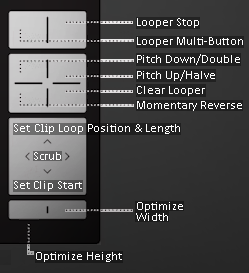
Return Looper & Clip Loop, Optimize View.
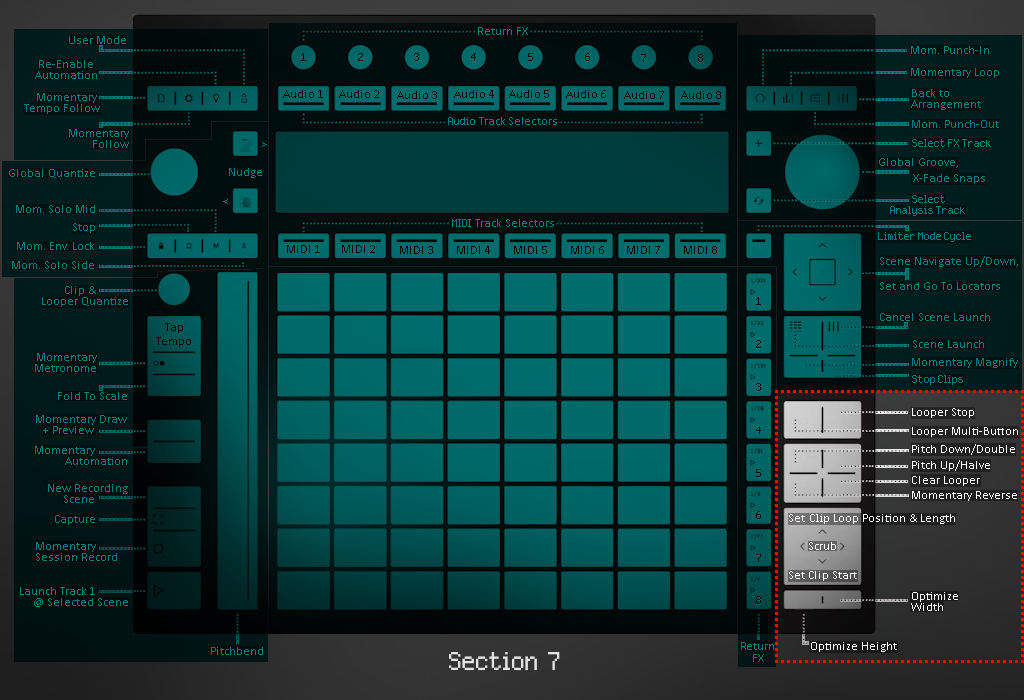
[_Looper Controls_]
Reset Button: Looper Select & Multi-Button.
Works the same as in non-user mode.

Accent Button: Looper Stop.
Works the same as in non-user mode.

Double Loop Button: Pitch Down & Time Double.
Works the same as in non-user mode.

Duplicate Button: Pitch Up & Time Halve.
Works the same as in non-user mode.

Convert Button: Momentary Reverse.
Works the same as in non-user mode.

Delete Button: Clear Looper.
Works the same as in non-user mode.

[_Clip Controls_]
Octave Up Button: Set Clip Loop Position & Length.
Works the same as in non-user mode.

Octave Down Button: Set Clip Start.
Works the same as in non-user mode.

Page Left Button: Scrub Clip Backwards.
Works the same as in non-user mode.

Page Right Button: Scrub Clip Forwards.
Works the same as in non-user mode.

Shift Button: Optimize Height.
Works the same as in non-user mode.

Select Button: Optimize Width.
Works the same as in non-user mode.


Section Eight:
Return FX Buttons.
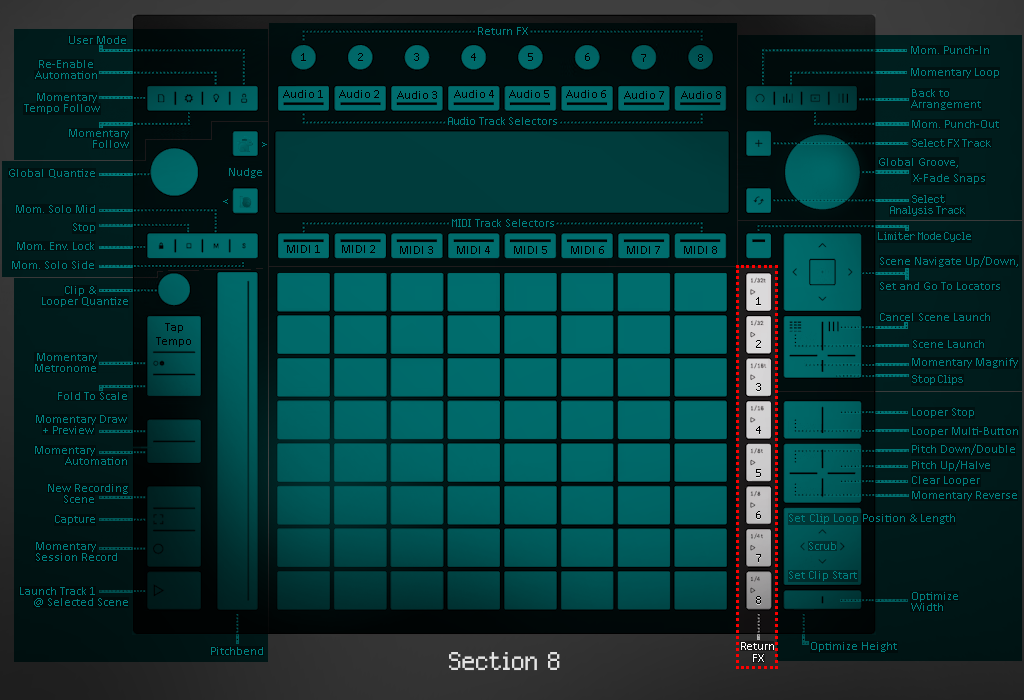

Repeat Interval Buttons: Return FX .
 Hold down one or more of these buttons to enable Return FX, and use the Encoders to manipulate the macros.
The template’s Return Effects are:
1. Beat Repeat.
2. Convolute.
3. LR Delay.
4. MS Echo.
5. Filter Delay.
6. GrainShimmer.
7. Reverb.
8. Resonators.
 These are a lot of fun to play around with!
 Hot Tip: to keep an effect on and free up a finger, switch User Mode off while a button is held down, then let go and switch back to User Mode.


But What About the Pads? — Bonus Instruments!!

 The Pads are used for playing notes of midi instruments. The Push 3 user Mode Template includes eight MIDI channels pre-loaded with native Ableton Live instruments that are optimized for play with User Mode’s pad MPE. One of the reasons this blog post is late is because I spent a bunch of time getting lost in playing them!

User Mode Pad Features_
• One copy each of Ableton’s flagship stock melodic synths, easy to switch between and mess around with.
• Scale & Pitch devices on each; press ‘Y‘ to enable scale-aware mode, so everything plays in the set’s Key & Scale!
• ‘User’ synth patches which are modest edits of the factory defaults, made extra MPE-capable.
• MIDI Filters in place to prevent other button touches of the Push controller causing unwanted MIDI notes.


What’s with these Return Tracks?

 There are three Return Tracks built into the PerforModule User Mode Temaplate.
FX.
Looper.
• Analysis.


 The FX Return allows you to send any audio to it to have layers of parallel fx added in.
 The Looper Return allows you to send any audio to a Looper, manipulatable with the Push.
 The Analysis track allows you to send any audio to, with Hi Res & Average Spectra plus analog-style VU & Peak Meters.


FREE Template!

System Requirements: Ableton Live Suite 12 (also make sure to have the Convolution Reverb pack installed).

Download the Push 3 User Mode Template. <-(under maintenance… available again soon)

 The project also includes a version combining together the User Mode Template and the recently-released Key Map Template. I use that one for my Deafult Ableton Live Set.
 Either are excellent for diving in and being creative at a moment’s notice, with a wide-open, sandbox feel.


Momentary FX Reference List.

 Here’s an alphabetical list of the controls that will switch on, then off again when you let go.

•Momentary Arrangement Loop.
•Momentary Automation Mode.
•Momentary Draw + Preview.
•Momentary Follow.
•Momentary Looper Reverse.
•Momentary Magnify.
•Momentary Metronome.
•Momentary Punch-In.
•Momentary Punch-Out.
•Momentary Return FX Enablers.
•Momentary Session Record.
•Momentary Solo Mid.
•Momentary Solo Side.
•Momentary Tempo Follow.

 A trick to get momentary controls to stay on is to switch User Mode off while one or more are held down; then let go and turn User More back on. To then switch a control that has been retained this way back off again, tap it whilst in User Mode.

DeathStalker Released!

Finally.
After 2+ years since the conception of the idea thru research and development, the DeathStalker Audio Effect Rack for Ableton Live is finally here!

What is DeathStalker?

Quite simply, DeathStalker is an Audio Effect Rack that makes guitars sound better.

It’s optimized for heavier distorted guitar tones, but can also sound amazing on clean or modulated electric guitars, acoustic stringed instruments, or just about any instrument.


Continue reading

Tempo Dynamics

When applying dynamic effects, we are rarely going to need the entire timing ranges available, depending on the tempo, right? The new Tempo Dynamics pack provides go-to racks with minimum and maximum values hard-wired to ranges most potentially useful, given the chosen tempo — avoiding values that are likely too fast or too slow to be helpful.

Continue reading

New Years 2023 Freebie: “Introspection” Pack.

Effect Racks for Live Intro.

‎‏‏‎ ‎‏‏‎‎‏‏‎ ‎‏‏‎ ‎ ‎Since my son has now acquired Ableton Live 11 Intro, I thought it would be interesting to make a pack of effects that utilize only effects native to that iteration of the software. These include Audio Effect Rack, Auto Filter, Auto Pan, Beat Repeat, Channel EQ, Chorus-Ensemble, Compressor, Delay, EQ Three, Erosion, Gate, Grain Delay, LFO, Limiter, Looper, Phaser-Flanger, Redux, Reverb, Saturator, Tuner, and Utility. This is no paltry collection to smirk at! Quite a range of possibilities. But also — a nice change of pace, being arbitrarily limited in options according to what I am used to as a rack craftor. I saw it as an exciting challenge. At the end, I’m super proud of what I’ve come up with. Methinks I’ll definitely be using these racks in the full version of Live 11 Suite aplenty moving forwards.

~`~

-> Download the Introspection pack for Ableton Live Intro, Standard, or Suite <-

(or acquire via Gumroad if you prefer).

Read about the process of the device creation below.


Continue reading

Parallel-Friendly Native FX Racks for Live 10+: “ParallAux”

Which Effects Work Best In Parallel?

So one day i got it in my head to figure out which of Ableton Live’s Effects are the best to use in parallel.

What is the criteria for this? Simply, which processes alter the phase of audio passing through them, either to the least degree, or in a nicely summable way.

Why does this matter? Because phase offsets, when summed in parallel with the original signal, will inevitably cause changes to the frequency contour. Sometimes slight amounts of this phase offset can add a nice creamy touch to the sound of things (and pretty much all analog gear causes it to some degree), but when being surgically technical like during the finalizing stages of a track, they are generally just not helpful.

An example of not altering phase at all is Live’s Compressor effect which is phase-neutral; it can be used safely in parallel with no unwanted frequency coloration whatsoever.

An example of altering the phase in a “nicely summable” way is Live’s Reverb. Technically, it’s altering the phase a whole bunch, but it’s doing so in a time-smeared fashion which results in far less likelihood of perfectly-lined-up frequency cancellations, and so, when at 100% wet, reverbs can be just fine to use in parallel, and are often preferred this way.

After carefully checking the phase response of all of Ableton Live Ten’s native Audio Effects, i came up with five distinct racks providing combinations of the most parallel-friendly native effects, optimized for specific purposes with maximal versatility of application.

~`~

>Check Out ParallAux via Isotonik Studios<

>Download ParallAux PDF Manual<

Continue reading

Repurposing Bad Controller Knobs

Improvisational Optimization

It’s always been more of my mentality to try to figure out how to make optimal use of what i have on hand — even when flawed — than to try to find immediate replacements… from using a TI-83 calculator to code as a teenager (since that’s what i had access to), to learning how to mic two small guitar amps to sound amazing rather than try to buy bigger amps which i didn’t have space to store. Whether or not this is the optimal way to be, it’s been pretty ingrained in me over a lifetime of dealing with less-than-ideal equipment and environs, figuring out how to increase functionality past apparent limitations, and squeezing every drop of valuable usage i could garner out of existing gear.

~`~

Bad Encoders!

This BCR-2000 MIDI Controller i have happens to have a top row of encoder knobs which act all wonky, sending out their values all slow and choppy and making them pretty much unusable as MIDI controls. However, each knob does have a set of LED lights, and it is possible to send messages to those lights to make them move.

By using a couple of MaxForLive devices in Ableton, i have it set up so that the 8 knobs each provide a VU-meter type experience in reaction to whatever’s playing in Ableton Live. Now they aren’t useless! Yay!

Continue reading

Beat Shaker for Beat Juggling

⠀⠀⠀I haven’t performed as a DJ in years, focused on raising my son and home studio work instead, but i was pretty active as one around the Colorado Springs area from about 2010 until 2014. One of the my favorite toys to use to manipulate beats live on my laptop was Alexkid’s Instant Haus, which “instantly generates drum patterns to craft into your own house track” (available free via Ableton). It’s great way to add variation to beats in an organic fashion.

⠀⠀⠀Well, i’ve been inspired lately because we now have available the freshest incarnation of beat juggling voodoo in the form of the 501k Creatives new Beat Shaker device, crafted by the very same Alexkid. It’s a similar concept, but greatly expands on the potential and flexibility.

Continue reading

Social Isolation Freebie: “Secret Weapon” Racks.


***Note: “Sweetie Pies” has been updated for Live 11 Suite! Grab the Live 11 version here.

(For the original Live 10 version, continue below.)


While we’re going through some crazy times, it has been heartwarming to experience how humans have upped their compassion game in response to shared crisis. I’ve seen more freebies and crazy deals going on this past week than any other time i remember, which seems because people want to help each other, share and be nice (well, not so much a certain political faction in the usa who seems to prefer that regular people suffer as much as possible. But that’s another topic). With graciousness and care for their fellows is how humans should act, rather than trying to take advantage of each other sleazily—which happens all too much.

In this spirit, i am offering up my super secret stash of “Sweetie Pies”—a small collection of effect racks for Ableton Live Suite 10, each crafted to address a specific need in a sweet manner. These are highly practical yet fun racks with the primary purpose of “getting stuff done”.

i WAS planning on releasing this pack eventually anyways once it grew a bit more, but to expedite the process of getting you the goodies, i’ve decided to simply omit the not-quite-finished devices, give everything a good once-over, and release the pack for free as it is now.


SO WHAT ARE THESE GOODIES OF WHICH YOU SPEAK?

Continue reading

Array Mbira Pack by Sonic Bloom

The mbira (aka kalimba aka thumb piano) has a peculiar sound all of its own. I think they tend to sound pretty cool, with a distinctive tone that is reminiscent of some other types of instruments but not quite exactly like anything else.

But what’s this? The Array Mbira? It has four octaves, you say? Including multiple copies of the notes? Well, then. That’s sure nifty.

The Array Mbira


Madeleine Bloom, whose Ableton Live Tutorials i wholeheartedly recommend, has sampled one such Array Mbira and assembled the results into a series of 34 Instrument Racks for Ableton Live. There are only a small handful of Ableton Live instrument craftors whose work i’ve encountered that put in the depth of care that i consider the level of the adept, and Sonic Bloom is one such. I’ve had the grateful opportunity to give the instruments a deep look and am here to report on my findings.

Continue reading

Organizing Your Ableton Browser Like a Boss PART 2: Custom Categories!

You might have already checked out the post about organizing your User & Plugin Presets like a boss using Ableton’s built-in folder architecture.

Well, now we’re ratcheting it up a level to give you ultimate control of your own personalized device organization structure, with the ability to decide exactly what those categories will be.

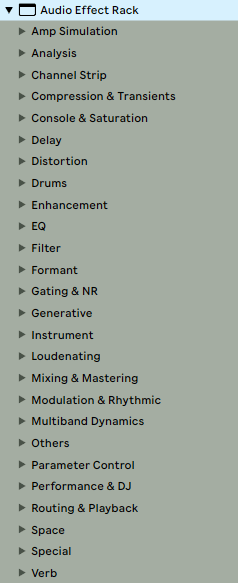
Modified Audio Effect Categories

If you’re like me, you’re obsessed with systematizing your production tools and resources into a cohesive configuration, making it easy to access what you want when you want it, for maximally optimized workflow when diving into creativity.

While working along with the default categories for years, i was never quite fully satisfied by Ableton’s built-in selection of available choices, so i did some research and testing and determined that it’s not only possible, but actually fairly easy to set up your own custom categories. The trick is to plan things out logistically.

If at this point you have no idea what i’m talking about, please check out the above-linked blog post for background on how Ableton’s category structure works. Then come back here and continue on. The gist is that by including devices in folders of particular names, you can get them to automatically show up in Live’s Core Browser. Normally, we’re relegated to using the default built-in categories that Live comes supplied with. All PerforModule Premium Packs are set up with devices like this, so they install and devices show up in the Core Library for anyone who purchases them. But now, should you want to, you can modify those actual categories. Sweetness.

Virtual Folder Config

The trick to setting up your own categories lies with the VirtualFolders.cfg file.

VirtualFolders.cfg Locations (for Ableton Live 10, similar for Live 9)…

PC:
C:\ProgramData\Ableton\Live 10 Suite\Resources\Core Library\Ableton Folder Info

Mac:
Ableton Live Application (show package contents) > Contents/App-Resources/Core Library\Ableton Folder Info

Always Back Up!

When starting out on this mission, firstly save a copy of the original VirtualFolders.cfg file in a safe place in case you make a mess out of things and need to restore the default state. You can always reinstall Live to do so as well, but that’s not necessary if you back up the file.

In addition, you definitely, absolutely will want to save a backup copy of your own custom-crafted VirtualFolders.cfg in a safe place, because every time Ableton updates Live, it will get overwritten and you’ll need to replace it (just like with Themes aka Skins). Maintaining a backup of your custom configuration is essential in order to continue using it in the future, so do not forget to save a copy of it after you complete it.

Your Custom Configuration

If you open up the VirtualFolders.cfg file in a text editor (such as the recommended Sublime Text 3) and gaze around at it for a while you’ll get an idea for how things work.

Virtual Folders are arranged in Groups. Each Group can include an arbitrary number of Virtual Folders, which will be the names of the folders that show up in Live’s browser. Each Virtual Folder allows two parameters: the Name (a single string of text that will show up as the category title), and the Patterns, a list of text strings which will trigger search results for devices in that category. Neat!

To set up your own system, simply alter the existing entries, and/or add your own new ones. I would recommend starting slowly, perhaps by adding in one new category to one group and testing it out, before planning a major overhaul to the entire scheme. Be extra cautious about deleting existing options, since while doing so won’t affect any devices directly, it may reduce your ability to easily access certain existing patches.

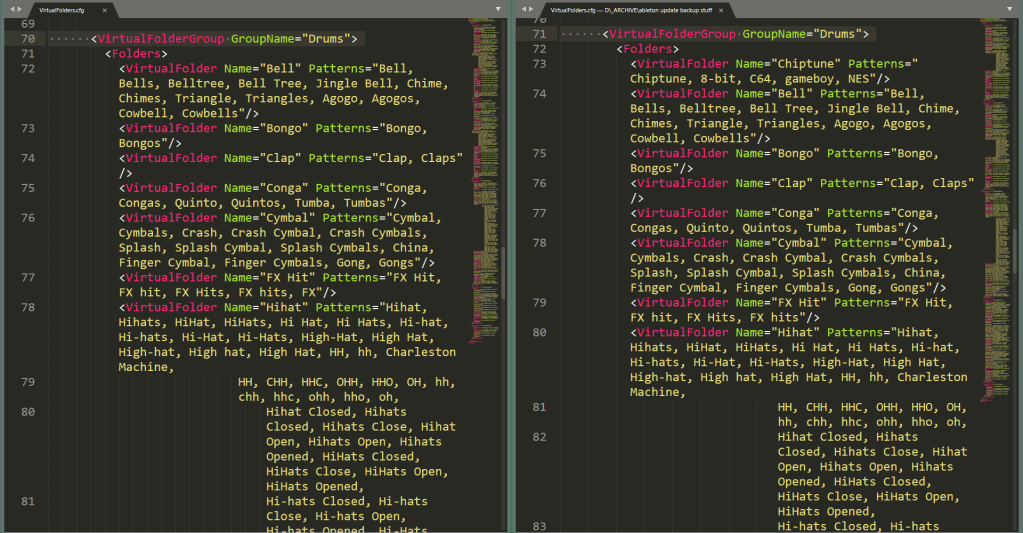
In the image below, see how on the right i’ve added the “Chiptune” Virtual Folder to the Drum categories. Now i can find chiptune-style drum hits easier. Radical.

After you backup both the original and your new configuration, replace the original with the new one, restart Live and check out what happened. Chaos? Euphoria? Now ponder whether you made a wise decision.

PerforModule’s Configuration Strategy

I’ve found Ableton’s default categories for the Sounds group to be mostly adequate, and so i haven’t altered much there. Notably, i’ve removed the “Booms” entry (new with Live 10), which i find useless and annoying to exist as its own folder, since anything i’ve found that could be classified as such could instead fit into a more appropriate category.

Because i was already invested in having sorted thousands of patches into the existing categories, it made sense for me to keep them, but perhaps in your case it might be a good idea to reassess the default categories and use ones instead that make more sense to you. Perhaps you would prefer to have multiple categories of basses available, for example—coordinating your clean, distorted, and wobbly bass patches separately. I might change “Synth Misc” into “Chiptune”, since that’s basically what i use the category for anyways…

Note that the Drums group is for drum hits, not drum racks. (Unfortunately, i’m still not sure of a way to suavely organize drum racks by type, so for those i still use User Library folders.)

The AudioFx group is where i’ve shifted stuff around a bit more.

The “Analysis” category is added, and it is much welcomed.
“Distortion” has keywords added so that degradation effects show up there.
Various effects previously crammed within “Mixing & Mastering” have been granted their own categories…
I’ve added a “Compression & Transients” category to align with the Elemental Mixing Template.
“Gating & NR” category for dynamics-increasing and noise reduction effects.
“Console & Saturation” has been added as a category, since i tend to use those for different purposes than more overt distortions.
“Delay” (previously placed inside “Modulation & Rhythmic”) now has a dedicated category.
“Enhancement” category added for exciters and other special-purpose, hard-to-categorize processors.
“EQ” now has its own category apart from “Filter”.
“Generative” category added for audio effects that generate sound.
“Channel Strip” category added for multi-effect chain plugins.
“Loudenating” category (shoutout to chris from airwindows for that term) added for limiters, maximizers… things whose purpose and result is to make stuff louder.
“Multiband Dynamics” category added, because those beasts are unique and special-purpose enough to have their own demesnes.
“Parameter Control” category because all those MaxForLive gadgets are so damn nifty to have on-hand in an accessible fashion.
“Routing and Playback” for all the odd toys that do strange things with channel routing, signal sending, and et cetera.
“Verb” because why the heck is there not a reverb category to begin with? They used to live in “Space”, which now i can designate only for things to do with stereo panning, perceived positionality, phase, and depth of field.
“Drums” and “Instrument” still exist as effect categories, and are used for instrument-specific plugins (examples: eddie kramer DR, bass professor).

Should you use the same custom categories as me? Probably not. But you can use these examples as thought-food to inspire your own devious system planning that suits your particular preferences.

But Why?

“I can just custom organize stuff however i want in my User Library, and ignore the Core Library. What’s the practical point of this?”

I dunno… i guess if you’re an anal-retentive nerd. It just streamlines stuff and feels like a cleaner, more unified experience. If you can’t see the appeal, then this is not for you. Have fun with your disorganized midden heap of chaotically-organized junk. Just kidding. It’s all love. Well, mostly.

Limitations

As swagtastic as implementing a custom system in this way feels, it’s still far from perfect. There are various improvements that could certainly be had.

Being able to classify individual Samples, Loops, and Clips might be kinda neat. As mentioned above, drum racks don’t count as a group like the other device types, and that’s kinda dorky.

Being able to access things with a sort of tag-style metadata system might be more elegant than folder trees. I know some DAWs can do this.

What would you add or change?